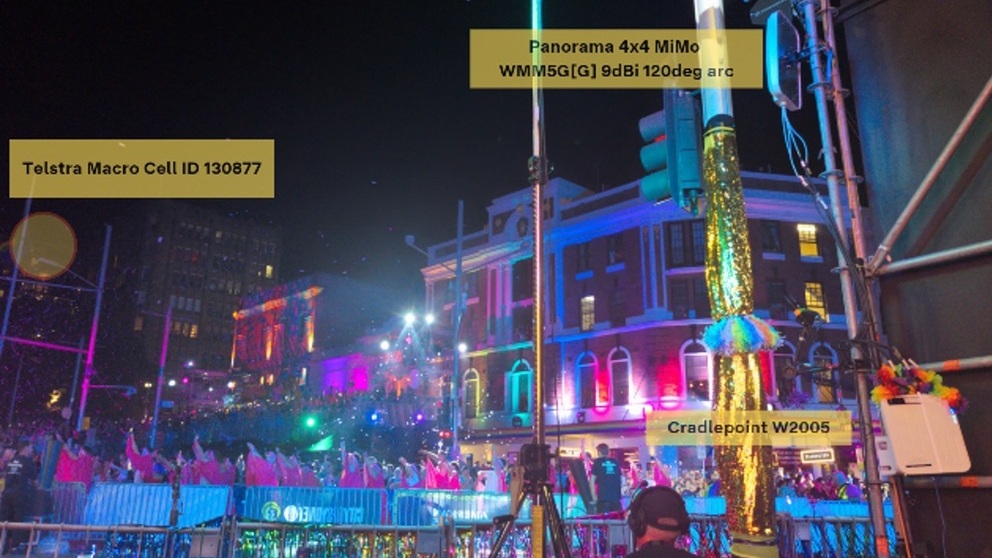
This paper examines the collaborative efforts of BBC R&D, TV2 and Neutral Wireless to investigate and optimise 5G for low latency production in TV studio settings and multi-camera outdoor broadcasts, which in many aspects differ from newsgathering.
Public and private 5G networks have proved useful for electronic newsgathering where latencies of up to 2 seconds can be tolerated. 5G Networks introduce jitter and delay into the data path as consequences of the uplink scheduling process and retransmission mechanisms that manage transmission errors and packet loss. However, low latency broadcast production and audio applications need much lower delays and more stable performance. The performance depends upon the vendor implementation and its configuration. Previous projects reported significant jitter spikes and concluded that 5G networks cannot readily support the 4 ms target required for audio performances requiring in-ear monitors. Tuning the 5G configuration to reduce latency helps, but there is often a trade-off between latency and spectrum efficiency.
This paper examines the collaborative efforts of BBC R&D, TV2 and Neutral Wireless to investigate and optimise 5G for low latency production in TV studio settings and multi-camera outdoor broadcasts, which in many aspects differ from newsgathering. We discuss the performance and optimisation of the scheduler, along with the latency/capacity trade-off. Our analysis demonstrates that...
Exclusive Content
This article is available with a Technical Paper Pass
Opportunities for emerging 5G and wifi 6E technology in modern wireless production
This paper examines the changing regulatory framework and the complex technical choices now available to broadcasters for modern wireless IP production.
Leveraging AI to reduce technical expertise in media production and optimise workflows
Tech Papers 2025: This paper presents a series of PoCs that leverage AI to streamline broadcasting gallery operations, facilitate remote collaboration and enhance media production workflows.
Automatic quality control of broadcast audio
Tech Papers 2025: This paper describes work undertaken as part of the AQUA project funded by InnovateUK to address shortfalls in automated audio QC processes with an automated software solution for both production and distribution of audio content on premises or in the cloud.
Demonstration of AI-based fancam production for the Kohaku Uta Gassen using 8K cameras and VVERTIGO post-production pipeline
Tech Papers 2025: This paper details a successful demonstration of an AI-based fancam production pipeline that uses 8K cameras and the VVERTIGO post-production system to automatically generate personalized video content for the Kohaku Uta Gassen.
EBU Neo - a sophisticated multilingual chatbot for a trusted news ecosystem exploration
Tech Papers 2025: The paper introduces NEO, a sophisticated multilingual chatbot designed to support a trusted news ecosystem.
Registered users only: Login