
Tech Papers 2023: This paper looks at answering the question of the organisational, technical, and functional requirements must be incorporated to adequately and responsibly respond to hybrid and more AI- orientated news practises.
Abstract
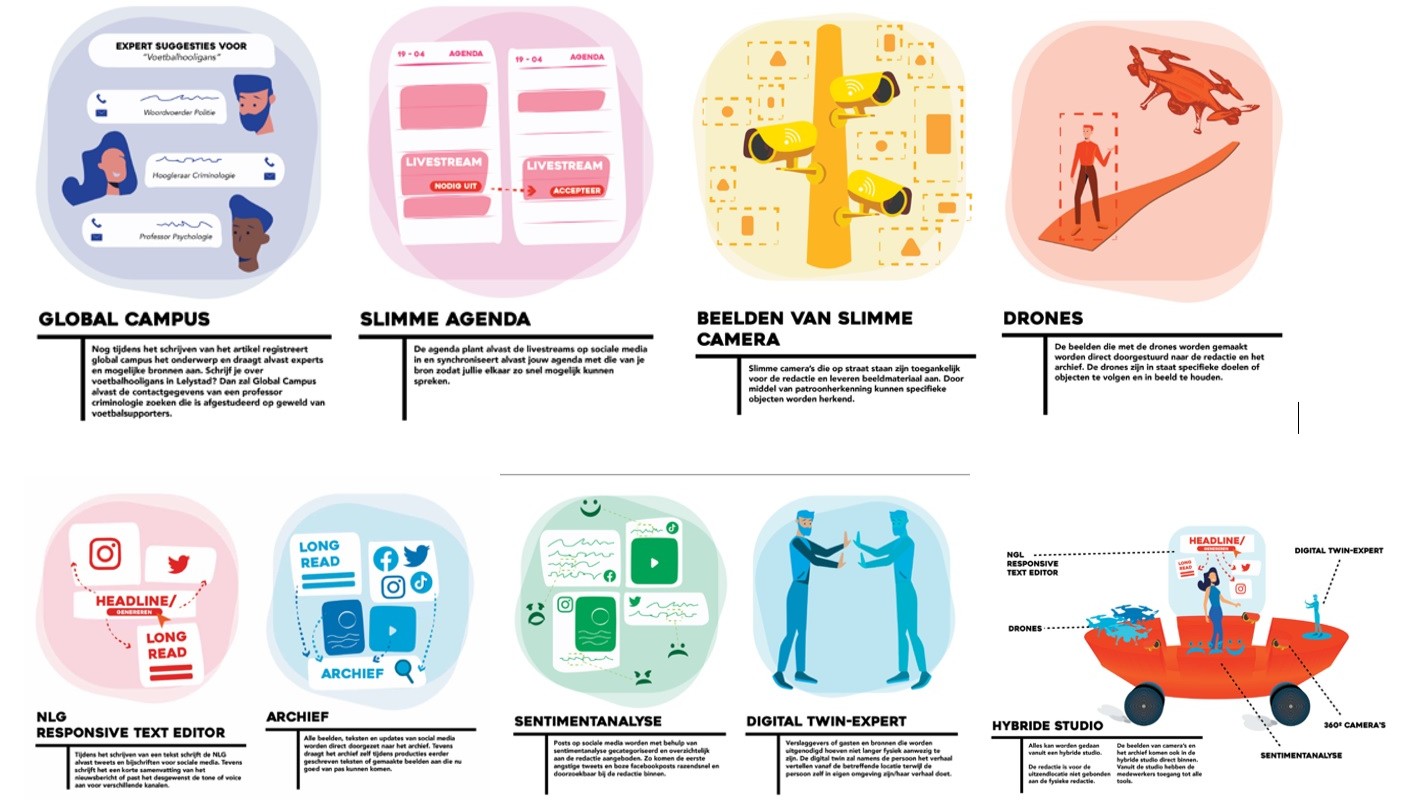
Journalists work with an editorial system daily; they use it to process their articles, communicate with colleagues, and produce and archive content. Yet even though editorial systems are the heart and backbone of the journalistic process, they are underexposed within innovation processes and journalistic research. This is remarkable because technological developments-amongst others, the rapid rise of Artificial Intelligence, offer numerous opportunities to revitalize editorial systems. In addition, new (hybrid) journalistic ways of working and operating call for a redesign of the editorial system.
In our research, 'The Editorial Portal,' a mixed group of experts from Fontys University of Applied Sciences (software engineers, AI experts, journalism researchers, and design researchers) investigated opportunities for a future-orientated editorial system where both organizational and technological transformations are considered. We understood that design methods, including context mapping, are suitable for identifying the relationship between editorial, system, corporate culture, and future developments. Journalists from four Dutch regional newsrooms consulted in this study call for a more intelligent system that encourages collaborative and creative working methods. Journalists, however, should be co-designing this new editorial system.
Exclusive Content
This article is available with a Technical Paper Pass
.jpg)
Dynamic power control for sustainable broadcast transmitter networks
Tech Papers 2026: This paper proposes an approach that uses predictive modelling in combination with real-time interference monitoring to optimise transmitter powers dynamically, with minimal impact on the consumer.
.jpg)
AI-driven anonymisation that preserves human performance
Tech Papers 2026: This paper presents two AI-driven workflows designed to preserve emotional nuance while ensuring anonymity.
.jpg)
Search first, inspect visually when needed: A multi-agent architecture for semantic video archival retrieval
Tech Papers 2026: This paper introduces Smart Chat, a multi-agent video question-answering system that searches indexed video moments, localizes candidate evidence, and inspects a short clip only when visual verification is needed.
.jpg)
A standardised framework for C2PA provenance in media workflows
Tech Papers 2026: This paper presents the first standardised framework for implementing C2PA for media provenance across newsrooms of varying sizes and operational contexts.
Dynamic streaming content packaging with C2PA
Tech Papers 2026: This paper presents an implementation of the approach adopted by C2PA for live video to dynamic packaging.
Registered users only: Login